About Robert Manzano

Art Mural "Puerto Rico Amazon Parrot"
Roberto Manzano is a graphic designer, illustrator, muralist, and art director originally from Puerto Rico who now also works in the United States. His work blends branding, large-scale murals, typography, and community-focused public art.
Some highlights of his career include:
• Advertising and design: He has worked with major advertising agencies in Puerto Rico, including BBDO, McCann, ARCO, and as an independent collaborator with agencies such as Saatchi & Saatchi, DDB, Ogilvy, and Havas Worldwide. His clients have included brands such as Don Q, Pepsi, KFC, Snickers, Scotiabank, and General Electric.
• Awards: He has received recognition at Puerto Rico's Festival Cúspide, earning Gold, Silver, and Bronze awards for advertising campaigns, including the TWIX campaign La Guerra de los Periódicos.
• Murals: In recent years, he has focused increasingly on mural painting and community art. One example is his "Puerto Rico Amazon Parrot" mural, celebrating the endangered Puerto Rican parrot (Amazona vittata).
• Style: His portfolio emphasizes bold color, bilingual communication (English and Spanish), cultural storytelling, and projects designed to strengthen community identity through visual art.
"Puerto Rico Amazon Parrot" - on Rooftop
Art Proposal

Designed proposal for our original rooftop agricultural project "Jardines de Cañamo". Designed to wrap around a small 4 sided structure situated on the roof.
Puerto Rico Amazon Parrot

Amazona Vittata - known to locals as the Cotorra Puertorriqueña or Iguaca . The only extant parrot endemic to the archipelago of Puerto Rico.
Mural In Process
Mural In Process
Art in Progress
Mural In Process
Mural In Process
Mural In Process
Art in Progress
Final Result
Mural In Process
Final Result
Finished Mural . When you arrive to our parking lot please look on the rooftop to see mural.
About Humberto Olivieri Ortiz
Art Mural Name: "Endémico"
Humberto Olivieri Ortiz was born in Aibonito, Puerto Rico, on June 5, 1984. From a young age, he was drawn to drawing and painting. While attending high school in his hometown, he won the Seguros Múltiples Co-op Art Competition. This award inspired him to continue his career and study fine arts with a concentration in painting at the Escuela de Artes Plásticas del Viejo San Juan.
Humberto is a very versatile artist; he has worked with a variety of media and supports.
His work includes acrylic, pencil, marker, and mixed media. His works are done on canvas, paper, cardstock, cardboard, wood, and murals, among others. He has a particular interest in PVC as a support. His subject matter is also very varied, with a particular inclination toward portraits, in which he achieves great expressiveness. He is also the author of numerous murals and has experimented with mosaics.
Humberto draws inspiration from his surroundings, as well as from the characters and images of Puerto Rico, and captures them with a unique touch and special sensitivity. He has also created the paintings and logo that decorate and identify a spa, as well as public figures, drawings of indigenous people, roosters, horses, family scenes, a mural of a patriotic cry, and a mural for a children's study area. He is characterized by his enthusiasm and dedication.

"Endémico" - Behind Tent #3
Art Proposal
Pájaro Bobo Mayor or "Big Bird"
Pájaro Bobo Mayor or "Big Bird"

Inspired by local endemic birds - "Big Bird" or "Pájaro Bobo Mayor" & "Goldfint" or "Pájaro Jilguero" found only in Puerto Rico forest like ours, The New Millennium Forest of San Juan.
Read more and see the illustration by our artist.
Pájaro Bobo Mayor or "Big Bird"
Pájaro Bobo Mayor or "Big Bird"
Pájaro Bobo Mayor or "Big Bird"
Coccyzus vieilloti - known to locals as the Pájaro Bobo Mayor or "Big Bird" is a long-tailed bird from wooded habitats. In their worldview, the hypnotic sound of its pendulum-like tail marks safe paths through the forest. This guardian symbolizes the connection with nature and ancestral wisdom.
Learn more and listen by clicking on image.
Jilguero or "Goldfint"
Pájaro Bobo Mayor or "Big Bird"
Chlorophonia sclateri - known to locals as Jilguero or "Goldfint" , a tiny and brightly colored species of dense forests where it forages at higher levels. Endemic bird that its a symbol of the soul, which remains linked to earthly life through the hand that holds it.
Learn more & listen by clicking on the image.
Mural In Process
Mural In Process

Wednesday Dec 17
Mural In Process
Mural In Process
Mural In Process
Bruno enjoying our new mural process
Final Result
Mural In Process
Mural In Process
Finished Mural by Tent #_3_
About Diego "Jaguart"
About the Artist
Diego Arnedo aka Diego Jaguart is from Buenos Aires, Argentina.
I started off my career by decorating nightclubs with enormous styrofoam/fiberglass sculptures and large scale murals. Then my art took me all over Central and South America painting and working in multiple mediums. While in Costa Rica, I became the artist in residence at Club Vertigo and decorated for international Dj’s, including scenography installations for the main stage. 10 years later I left my nightclub roots behind and headed to Brazil where I concentrated on my live painting performance, ART LIVE. This performance is characterized by using UV light and fluorescent paint.
In the studio, I typically begin my art pieces with an abstract of watercolors. Next, a mix of fluorescent and acrylic paints are worked into the design. I like to paint during the daylight with acrylics just as much as at night with blacklight and fluorescent acrylics. I switch back and forth between the different light spectrums and use 3D/chromadepth glasses to produce artwork with a tridimensional effect to be viewed -
- In Full Spectrum light (daylight)
- In Blacklight and
- With 3D glasses
As a final touch, I pinpoint specific areas to lay a resin finish.
Symbolism within Diego's Mural
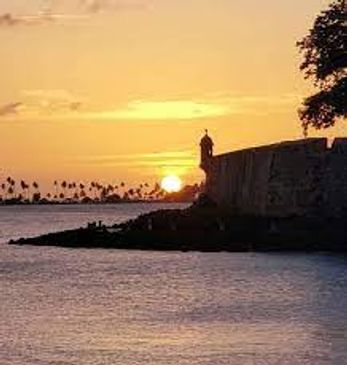
Atardecer
Atardecer
Atardecer
The special thing about sunsets in San Juan is the magical combination of golden light on historic architecture, a refreshing ocean breeze, and the vibrant atmosphere of the city as day turns to night.

La Garita
Atardecer
Atardecer
Today, "La Garita" are an iconic symbol of the city and its fortifications, as well as a reference point for locals and tourists. The term is also used in a broader sense for any guardhouse.
El Mar
Atardecer
Baile Folklorico
Puerto Rico's ocean is special for its three world-renowned bioluminescent bays, the deepest part of the Atlantic Ocean(the Puerto Rico Trench), and rich marine biodiversity. The island offers a unique combination of these features, from the glowing waters of bays like Mosquito Bay to the diverse ecosystems found along its coastlines and within the trench.
Baile Folklorico
Baile Folklorico
Baile Folklorico
"Baile folklórico" (folkloric dance) in the context of Puerto Rico refers to traditional dances that express the island's unique cultural heritage, which is a blend of Taíno, Spanish, and African traditions. These dances serve to revive and preserve Puerto Rican traditions and history.
Flor de Maga
Baile Folklorico
Zumbador Verde
Puerto Rico's national flower is the Flor de Maga (Thespesia grandiflora), a large, vibrant red or pink, cup-shaped bloom from a native tree, often mistaken for hibiscus but distinct, symbolizing the island's identity, beauty, and resilience, and used culturally for adornment and valuable timber.

Zumbador Verde
Baile Folklorico
Zumbador Verde
Native to Puerto Rico, the emerald buzzer (or green buzzer), being one of the best known hummingbirds. This bird is a symbol of pride, agility and resilience, and has inspired typical costumes and other Puerto Rican cultural aspects.
About the artists ; Matorral Creativo

Matorral Creativo
Matorral Creativo is a design and production studio that collaborates with designers, manufacturers, and artists to create spatial experiences and brand identities.
We specialize in interior design, master planning for conceptual architectural and landscape architecture projects, custom furniture design and manufacturing, and mural design for businesses and public spaces.
Our integrated approach within the creative industries allows us to collaborate with brand developers and concert and event producers to create experiences that make a difference and leave lasting memories for our clients.

Edgardo Larregui
In this collaboration from Matorral Creativo one of the artists, and community leader, is Edgardo Larregui. Born in Bayamón and raised between his hometown, Santurce, Puerta de Tierra, and La Perla, Larregui shares the family stories from the neighborhoods that shaped his childhood and adolescence. He was introduced to art through his cousin, a student at the Central School of Visual Arts, who encouraged him to decorate his everyday items: collages in notebooks, paintings on ping-pong paddles, and more. From elementary school, he learned about graffiti, appreciating its compositions and creativity. Later, while studying at the Central School of Visual Arts, he became interested in architecture and the illustrations he created using airbrush and watercolor.
Larregui recounts the dynamic atmosphere of the School of Visual Arts in Old San Juan and his exploration of connecting his childhood experiences with his new projects. In addition, he tells us about his new project "Forma con Forma" as his most recent entrepreneurial project, as well as his new artistic work whose support is aluminum.
Lizaimi Rivera Rivera
Our second artists in collaboration of this mural is Larregui's partner Lizaimi Rivera, which is a multidisciplinary artist and fashion designer.

Proposed Mural
We have requested Larregui and Lizaimi to introduce puertorrican traditional elements with our logo. This is the proposed mural.
Symbolism in "Matorral Creativos" Mural
Wooden Houses
Wooden Houses
Wooden Houses
Ancestral wooden houses in Puerto Rico, rooted in indigenous Taíno engineering, utilized woven wood and straw for structures designed to withstand high winds. These sustainable "jibaros" homes were often elevated to prevent flooding, featured cross-ventilation for cooling, and evolved from round indigenous huts to rectangular designs influenced by early Spanish colonial influence.
Parch Flower
Wooden Houses
Wooden Houses
The parch flower (Passiflora spp.), also known in Puerto Rico as passionaria, passion flower, or sometimes "mira melinda", mainly represents the passion of Christ due to its complex structure, associated by Spanish missionaries with the crucifixion. It is a popular tropical vine, valued for its beauty, aroma and the edible fruit used in juices and soft drinks.
Banana Leaf
Wooden Houses
Banana Leaf
The banana leaf in Puerto Rico has a deep cultural and culinary meaning, being indispensable for the preparation of traditional dishes such as cakes and guanimes. It brings a characteristic aroma and flavor to food, and has traditionally been used to wrap and cook food. In addition, it represents an element of tradition rooted in local ga
The banana leaf in Puerto Rico has a deep cultural and culinary meaning, being indispensable for the preparation of traditional dishes such as cakes and guanimes. It brings a characteristic aroma and flavor to food, and has traditionally been used to wrap and cook food. In addition, it represents an element of tradition rooted in local gastronomy and, historically, its leaves (and those of the bijao) were used to cover houses and make baskets.
About the Artist - Hector Soto Torres

Ekosaurio
Ekosaurio, Hector Soto Torres, is a Puerto Rican artist who began his artistic journey with graffiti at the age of 15 (2006) and, despite not having formal education in painting or drawing, he considers himself a self-taught artist. Passionate about art and design, he completed a degree in Environmental Design (BArch) and, in 2015, began creating public murals across Puerto Rico.
In 2016, he moved to Barcelona to pursue a master's degree in design (MDes), and since then, he has worked across various disciplines, including graffiti, graphic design, architecture, and furniture design. His inspiration comes from nature, particularly vegetation and flora. His art conveys a modern urban landscape that reflects energy and life in every space. By using vibrant colors, contrast, and organic forms, Ekosaurio creates pieces that evoke feelings of happiness and vitality, transporting viewers to a world full of color and harmony.

The Mural ; BELLEZA IGNORADA III
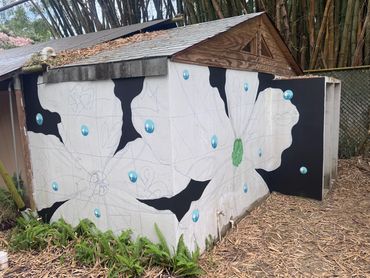
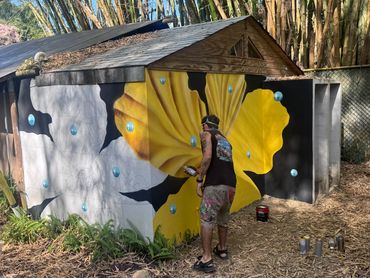
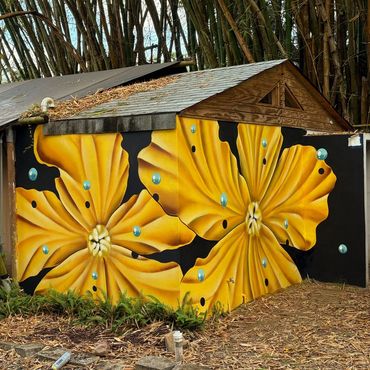
BELLEZA IGNORADA III
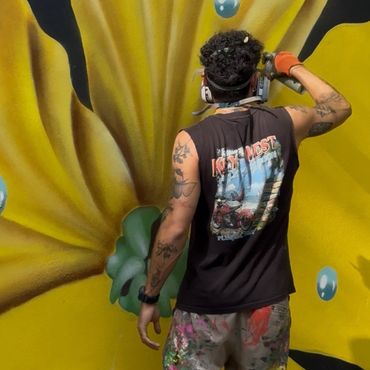
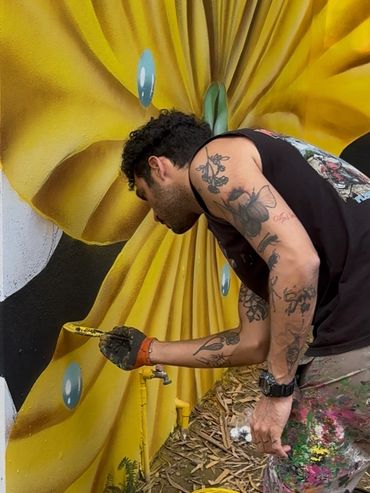
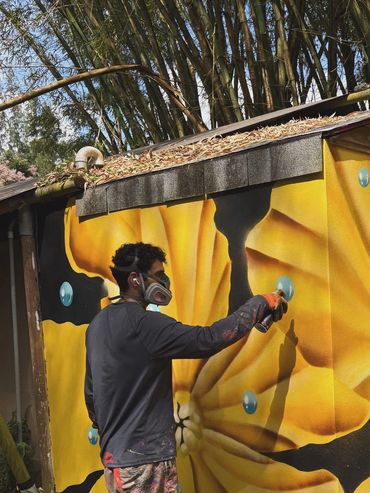
Based on the flower known as the Cundeamor, a very common plant in Puerto Rico known for its characteristic fruit and yellow flower. My intention is to highlight the vibrant details and colors within all the nature surrounding Jardín al Bosque.
This series of paintings stems from observing Puerto Rican wildflowers: those that grow along roadsides, in pastures, and in abandoned spaces.
I decided to paint a single flower on a large scale, sometimes focusing on a specific detail, as an act of amplification and admiration. By isolating it from the landscape and giving it scale, the flower acquires its own voice and greater presence.
These works do not seek to idealize the wild, but rather to admire its constant and silent presence. They are flowers that survive without permission, that bloom without an audience, and yet still hold beauty, resilience, and memory. Painting them is a gesture of attention toward what is normally ignored.
The inspiration...
Cundeamor (Momordica charantia), or bitter melon, is a common trailing vine in Puerto Rico recognized by its small, yellow, five-petaled flowers, palmate leaves, and warty orange fruit that splits open to reveal red, sweet-covered seeds. Commonly used in traditional medicine to treat diabetes, the leaves and fruit are known for their intense bitter taste.
The Process of BELLEZA IGNORADA III by Ekosaurio behind Tent #5
Proposed Mural ; "El Canto del Coqui"

El Canto del Coqui
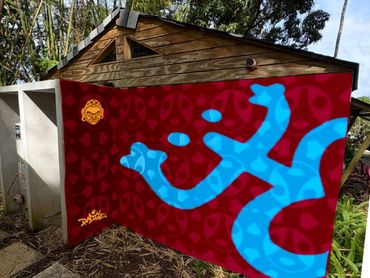
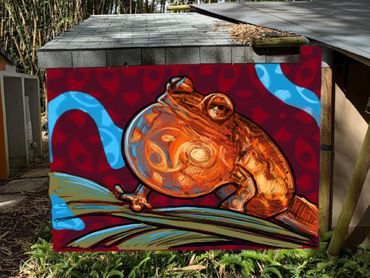
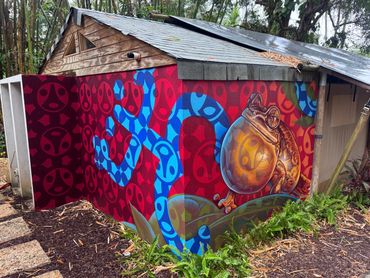
It's a coqui frog singing, highlighting the colors of the Puerto Rican flag 🇵🇷 with a pattern of Taíno suns. The suns are a hybrid of the Jayuya and Utuado suns. Finally, I incorporated the coqui symbol, which is so representative of us, with the light blue of the flag.
Symbolism within "El Canto del Coqui"
Singing Coqui
Suns of Jayuya & Utuado
Suns of Jayuya & Utuado
The coquí tree frog is a profound symbol of Puerto Rico, representing cultural identity, resilience, and indigenous Taíno heritage. Known as the island's "heartbeat," its distinct night song connects people to their homeland. The saying "soy de aquí, como el coquí" (I'm from here, like the coquí) signifies intense Boricua pride, signifying that, like the frog, one belongs to the island.
Suns of Jayuya & Utuado
Suns of Jayuya & Utuado
Suns of Jayuya & Utuado
The sun symbols in Utuado and Jayuya are iconic representations of Taíno indigenous heritage, deeply rooted in the central mountainous region of Puerto Rico. Known as the
Sol de Jayuya (Sun of Jayuya) and the Sol de Otoao (Sun of Utuado), these petroglyphs symbolize strength, health, divinity, and cultural longevity.
Taíno Coqui Symbol
Suns of Jayuya & Utuado
Taíno Coqui Symbol
The Taíno coqui symbol, a stylized, three-pronged, or petroglyph-style frog, represents fertility, the rainy season, and a deep connection to nature. Originating from ancient petroglyphs, it symbolizes the "mother goddess" Attabeira, embodying life, resilience, and Puerto Rican identity, often used to declare "I am from here" (De aquí como el coquí). .
Puerto Rico Flag
Suns of Jayuya & Utuado
Taíno Coqui Symbol
The Puerto Rico flag features three red horizontal stripes, two white horizontal stripes, and a blue triangle on the hoist side with a single white five-pointed star. Red symbolizes the blood of warriors, white represents liberty and peace, and the blue triangle symbolizes the sky and coastal waters.
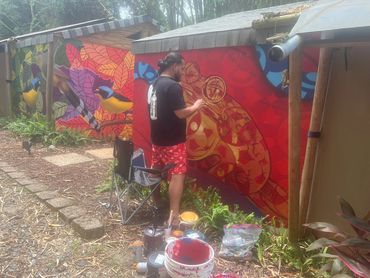
The making of "El Canto del Coqui" located behind Tent #4